By Debora Marines | Teach Magically
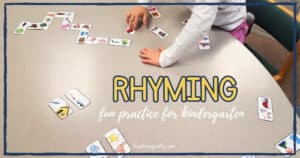
If you’ve ever watched a kindergartner proudly segment every sound in “frog” and then race to find the matching word card — you know that magic moment when phonics and phonemic awareness click together. That’s exactly what happens when my advanced kindergartners play Cluster Blend Dominoes, and I’m here to walk you through exactly how I use it so you can get the same results in your classroom.
(If you’re new here, I wrote about how and when to teach consonant blends and clusters back in 2018 — that post covers the “why” behind clusters vs. blends and when to introduce them. This post is all about the game itself and how to use it to build deep phonemic awareness.)
Why a Domino Game for Consonant Blends?
Most consonant blends activities ask students to look at a picture and write the blend. Simple. Predictable. And honestly? Not that hard once kids know their blends.
This game flips the challenge. Students read a CCVC word — like frog or sled — and then have to find the picture card whose name starts with the same consonant blend sound. They’re not matching word to picture. They’re matching a written consonant cluster to a spoken blend sound. That’s a whole different cognitive demand, and it’s exactly what phonemic awareness practice should look like.
Phonics + phonemic awareness in one game. The written word side practices phonics decoding. The picture side practices phonemic awareness. Kids are doing both every single turn.
What’s in the Phonemic Awareness Center Game
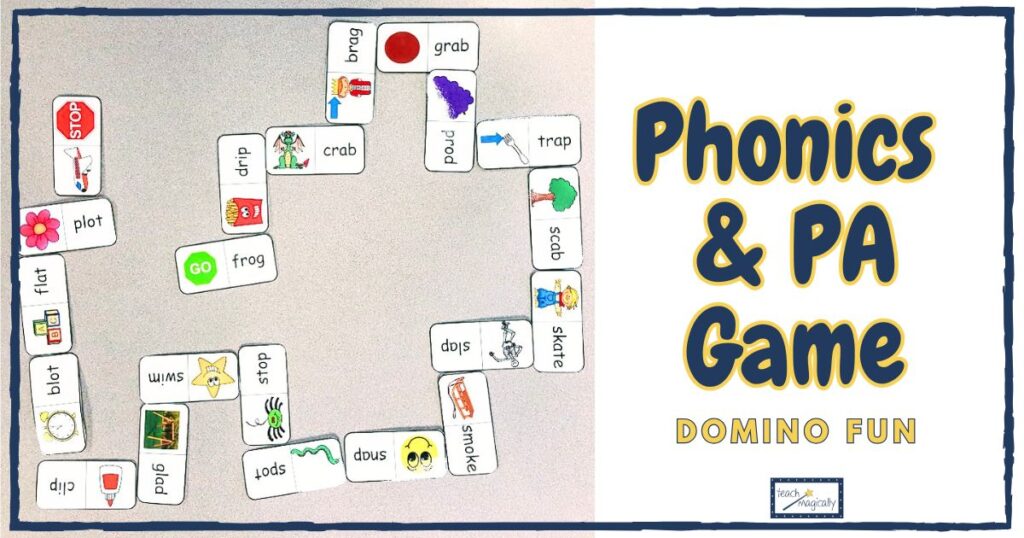
The Cluster Blend Dominoes set includes:
- 21 dominoes — colored and blackline versions (huge for printing budgets!)
- An explicit lesson plan so you know exactly how to introduce it
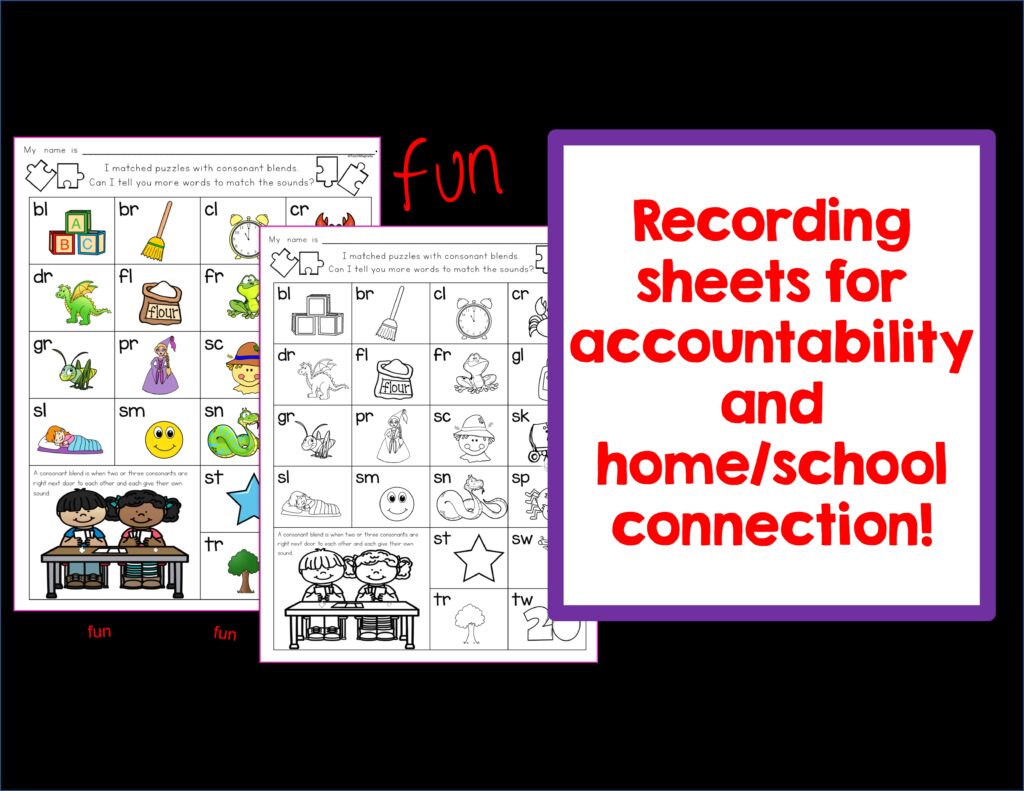
- A recording sheet in color and blackline
- Common Core Standards (RF.K.2, RF.1.2b, RF.1.3b)
- Center directions with pictures so students can run it independently
- A “Go” and “Stop” card to frame the game
The game goes from a “Go” card to a “Stop” card — if you’ve matched all the pictures correctly and land on “Stop,” you did it right. It’s built-in self-checking, which is a center teacher’s best friend.
How I Actually Play It with My Kindergartners
Here’s my exact routine with advanced kindergarten students. Feel free to adapt it for your group.
Step 1: Name Every Picture First
Before the cards go out, I tell students the word for each picture. Don’t skip this. Little ones can misread a picture (“Is that a crab or a crawfish?”), and if they have the wrong word in their head, the whole sound-matching falls apart. One minute of picture-naming up front saves the whole game.
Step 2: Deal the Cards Face Up
I deal the domino cards evenly so every student can see their own pictures — and each other’s. This is intentional. When cards are face up, kids can help each other, which turns the game from competitive to collaborative. It’s also a natural way to differentiate: stronger readers can support kids who are still developing blend recognition.
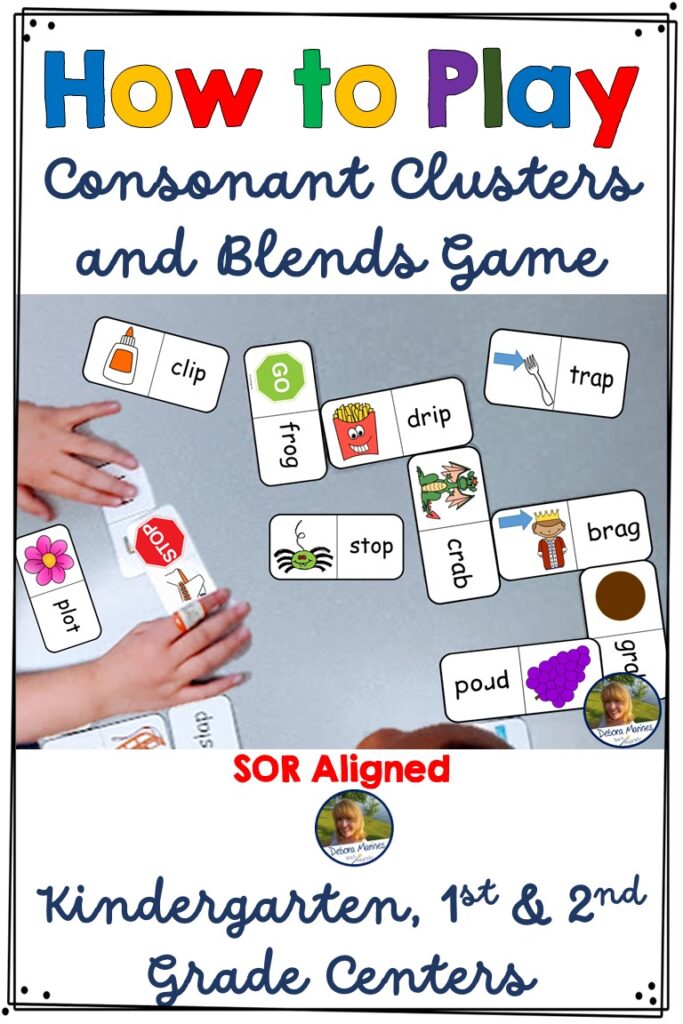
Step 3: Start with “Go”
Whoever holds the “Go” card starts. That student:
- Segments the CCVC word on the “Go” card using successive blending (more on this below)
- Reads the word aloud
- Everyone searches their face-up picture cards for an image that starts with the same consonant blend sound
The student who has the matching picture then reads the word on the opposite side of their domino — and the chain continues until everyone reaches “Stop.”
Step 4: Successive Blending Every Single Time
I always have students use successive blending when they read the domino words. This means:
- Start with the first two sounds: /f/ /r/… “fr”
- Add the next sound: “fr” + /o/… “fro”
- Add the final sound: “fro” + /g/… “frog”
This is especially powerful for students who know their individual letter sounds but struggle to blend them into words — which is exactly where most phonemic awareness instruction needs to happen.
How to Using the Recording Sheets (Two Ways)
The recording sheets do double duty, and I use them both ways depending on the day.
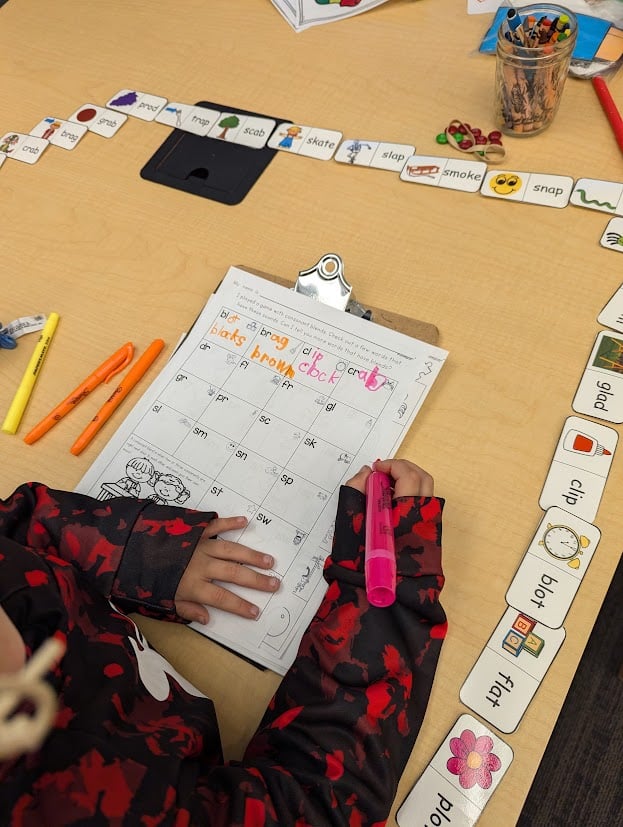
Option 1 — During the game: If a student finishes their turn or needs to stay engaged while others search, they color the card they were just dealt on the recording sheet. It keeps every kiddo busy and invested, even when it’s not their turn.
Option 2 — When time runs out: Real classroom life means centers don’t always finish cleanly. If the timer goes off mid-game, students can record the domino matches they completed — which also makes it easy to pick up next time, or to do as a quick formative check.
Bonus: Because the recording sheet captures which dominoes were matched, it’s essentially a new activity each time students record a different round. The game never gets stale.
Tips That Make It Run Smoothly
Keep the answer sheet handy. When you’re first introducing this game, have the answer key nearby so you can quickly confirm a match without breaking the flow. After a few rounds, you won’t need it.
Model “thinking aloud” for the blend match. Before students play independently, demonstrate the thinking: “My word is ‘sled.’ The blend is /sl/. I’m looking for a picture that starts with /sl/. Hmm, I see ‘slide’ — /s/ /l/ /aɪ/ /d/ — yes! That starts with /sl/!” Making the internal process visible is especially important for students who are still building phonemic awareness.
Don’t rush past the picture-naming step. Even after students are fluent with the game, spend 60 seconds naming pictures at the start of each session. It sets everyone up for success.
Use it as a small group assessment. Listen while students segment and blend. You’ll immediately hear who’s blending confidently, who’s guessing, and who still needs individual phoneme work. No rubric required.
Where This Game Fits in Your Phonics Sequence
This is not a day-one-of-consonant-blends activity. Students should already:
- Know their individual consonant sounds
- Have experience with CVC words
- Have been introduced to what consonant blends are and how they differ from digraphs
Once those foundations are in place, this game is the perfect bridge between “knowing blends exist” and “automatically hearing and producing blend sounds.” I use it with advanced kindergartners, but it’s equally powerful as a 1st grade center or intervention tool.
Grab the Game + Related Resources
You can find Cluster Blend Dominoes in my TPT store — it includes the colored and blackline versions so you can print once and use it for years:
👉 Consonant Blends Domino Game — TPT
Looking for more phonemic awareness practice to go alongside it? These pair perfectly:
- Sound Off New Word Lotto — great for phoneme manipulation practice
- Consonant Cluster and Blends Puzzles — a quieter center option for the same skills
- Rhyme Fun — for building the phonological awareness foundation (no words needed)
And if you haven’t read the original post on when and how to introduce consonant blends and clusters, that’s a great place to start: How to Teach Consonant Blends and Clusters
Have you tried Cluster Blend Dominoes with your students? I’d love to hear how it went — leave a comment below or tag me on social media!
Teach Magically,
Debora
Written by Debora Marines — an elementary education expert and creator of Teach Magically. She shares kindergarten literacy, math, and classroom strategies to help teachers build strong foundations for young learners.
©TeachMagically™ | teachmagically.com